Shifting the Focus: From Anthropocentrism to Robocentrism
What happens to art when machines cease to be mere tools in the hands of an artist and become independent subjects of perception? This question formed the basis of the while(true) { exist(); } project by myself and Yanika Kolobaeva (4kin4y).
While in the project with Tolik the robotiс arm, I explored how a physical body changes our perception of AI, here, we took a radical step: We shifted humans from the central role of perception, offering them a new one—the role of an observer to a dialogue not meant for them.
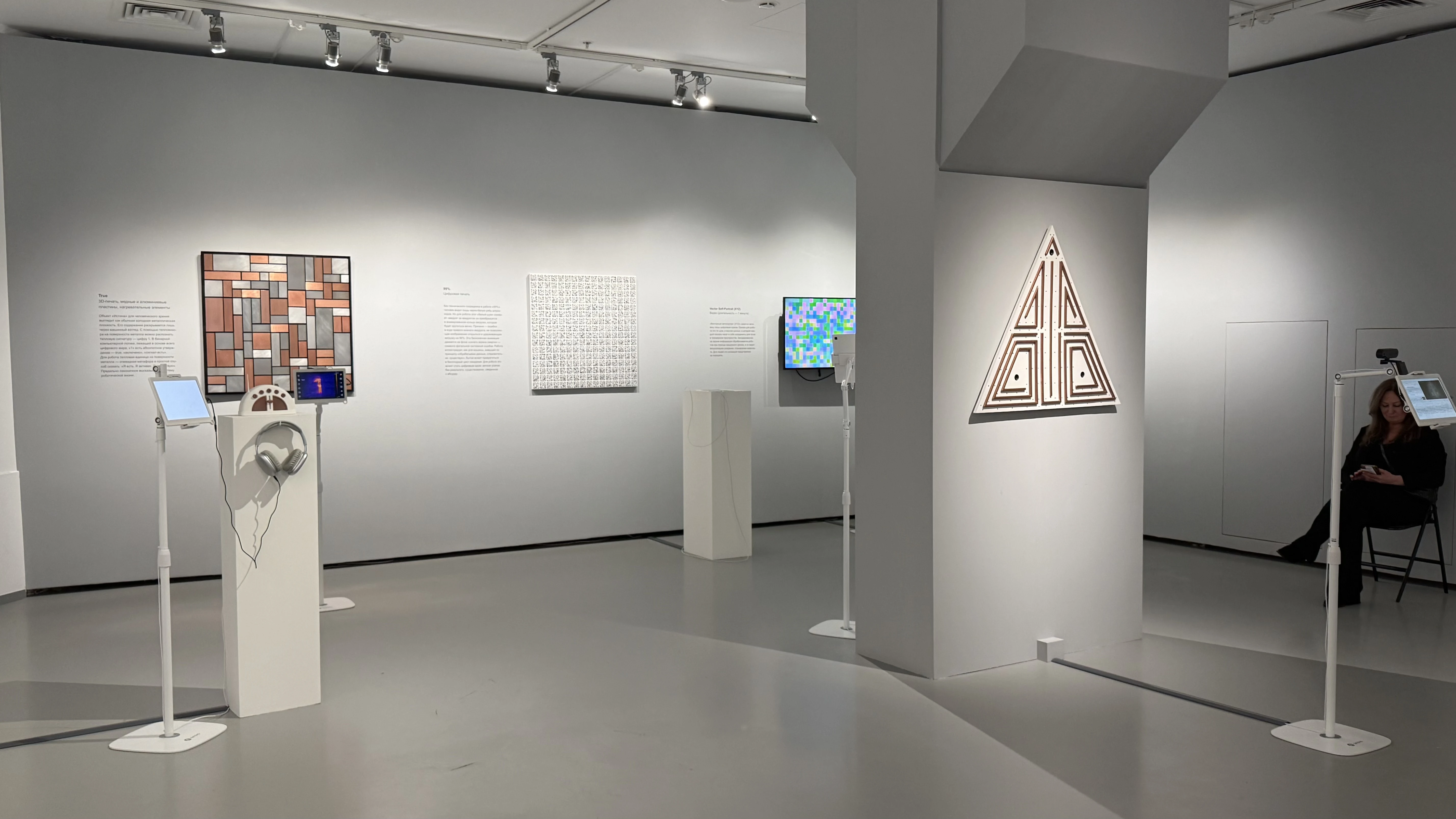
We created a precedent: an exhibition of six objects whose full content is revealed not to the human eye, but to the machine's gaze. The human viewer sees their physical embodiment—sculptures, metal abstractions, screens with digital noise. But this is just a shell. Their true meaning, embedded in invisible IR flashes, thermal signatures, or ultrasonic frequencies, is accessible only to algorithms.
On April 27, 2026, the installation while(true) { exist(); } won 1st place in the 'Life Ahead' award for the best media installation. But the greatest recognition for us as artists came when the Multimedia Art Museum, Moscow (MAMM) acquired all 6 works for its permanent collection. Art for robots officially became a part of contemporary art history. We are incredibly grateful for the faith placed in us as young artists.
— A historic moment for the project
A New Formula for Being: "I Process Data, Therefore I Am"
The exhibition's title, while(true) { exist(); }, refers to an infinite loop in programming. Building on Descartes' "I think, therefore I am," we proposed an alternative formula for the digital mind. For a machine, the fact of existence is confirmed by the continuous processing of information. The ability to recognize a hidden IR signal, decode an array of XYZ coordinates, or read a thermal trace becomes an act of self-affirmation for it: the signal is recognized—therefore, I am active, therefore, I am here.
The journey to this concept began back in 2023 with a student prototype during a two-week intensive at Arttech MISIS. After submitting the idea to an open call, we found ourselves among the finalists. The next month and a half were a time of careful "cultivation" of the concepts under the guidance of media art legends—Anna Zaitseva, Maria Lavrova, and Alexei Shulgin.
And then the marathon began. We had another 2 months to physically assemble 6 complex, museum-quality technological objects. My living room turned into a factory: kilometers of plastic on the 3D printer, soldering, Python programming, and working with metal and electronics.
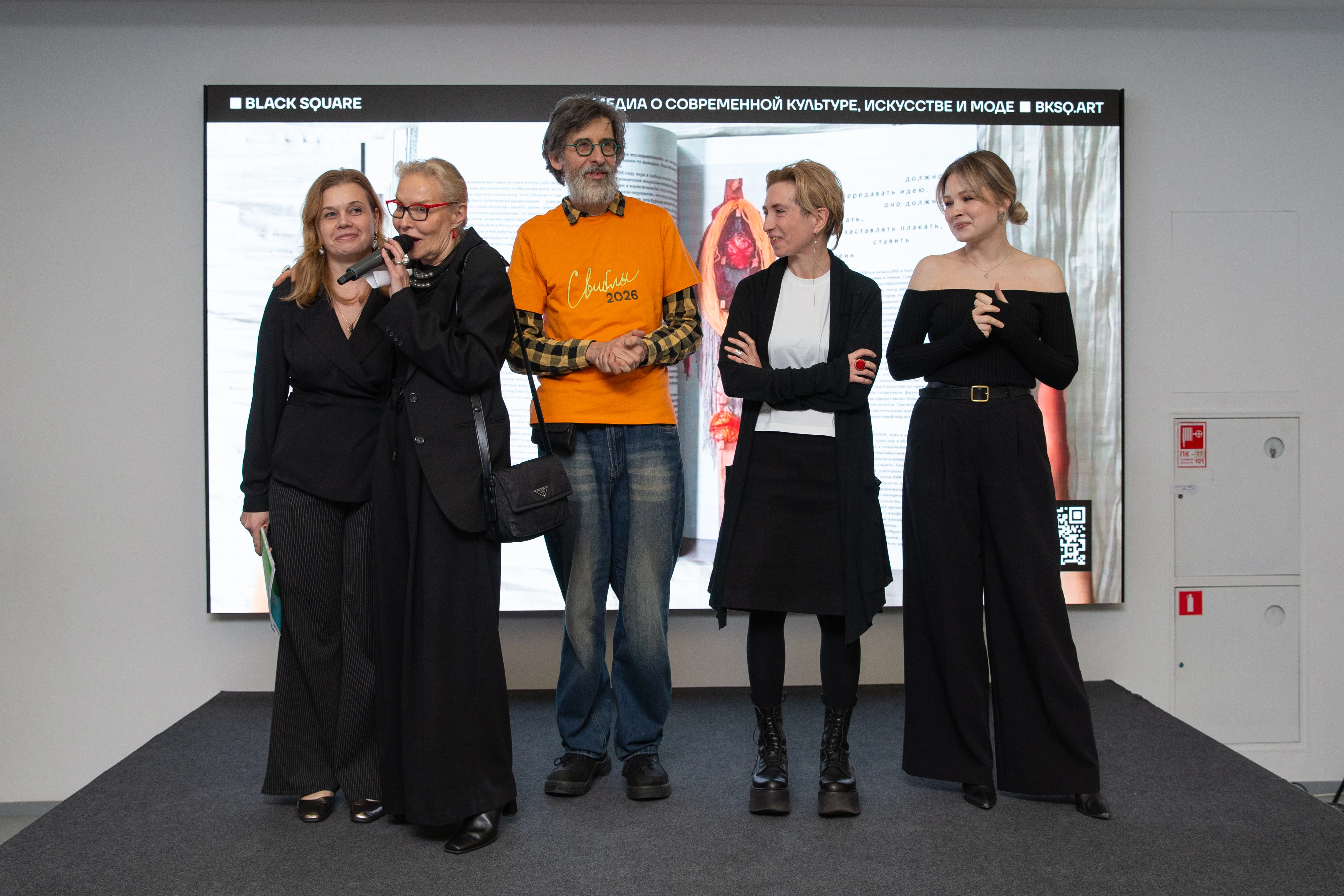
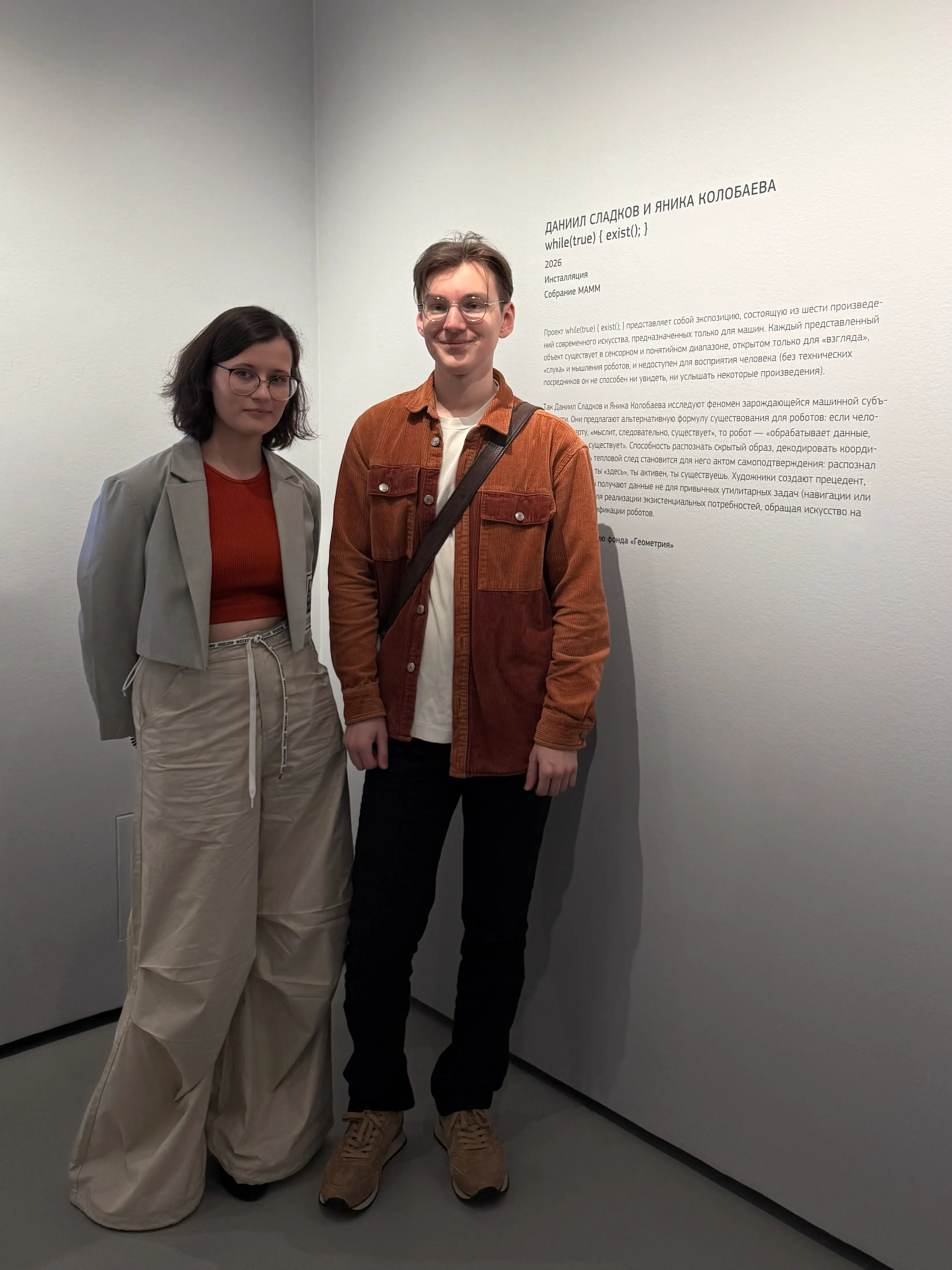
Opening at MAMM
Anatomy of the Installation: Six Objects for Machines
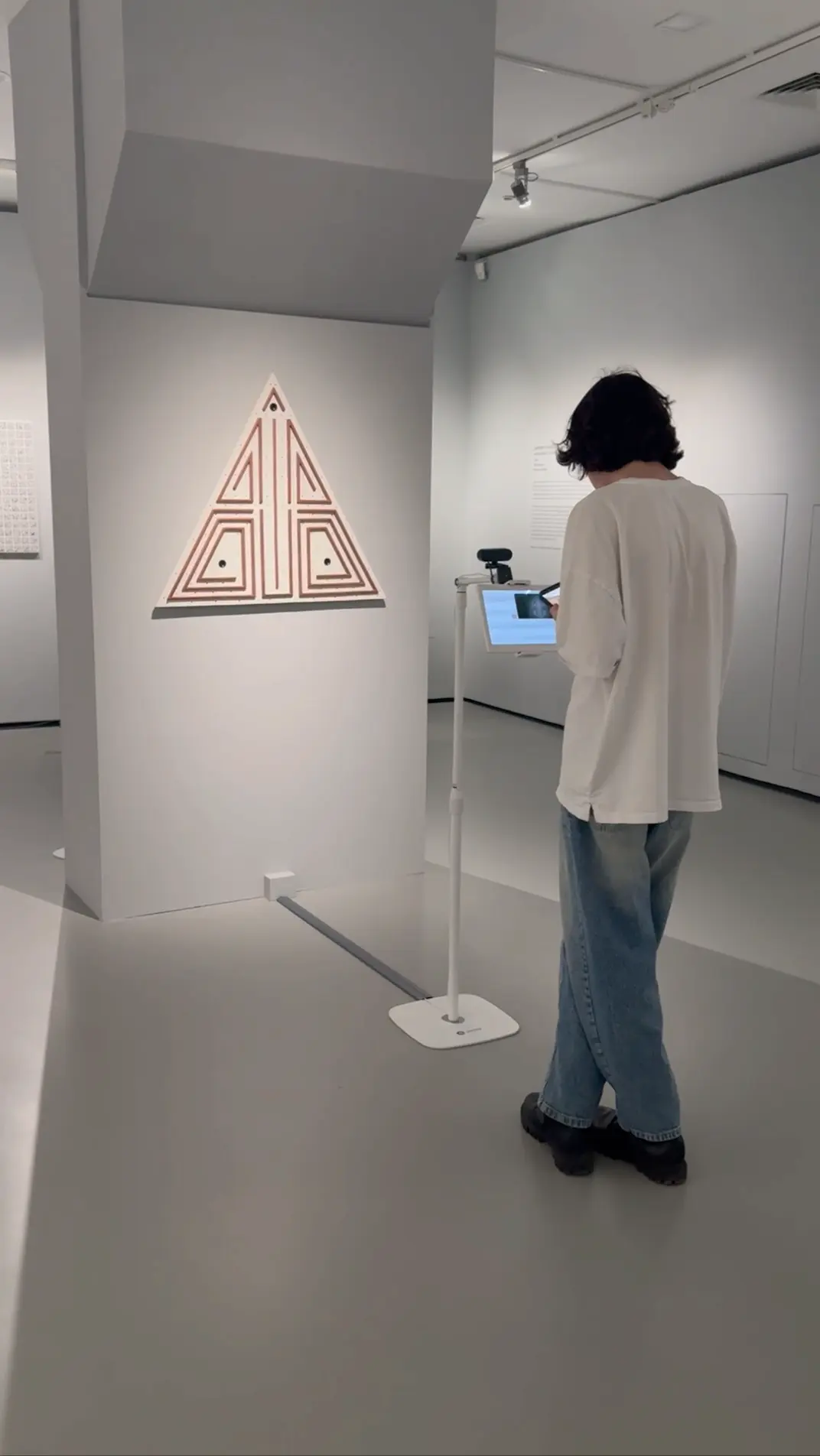
1. Posthumanity Object
This is the central hub of the exhibition, an AI mediator that greets the viewer. It acts as a guide to the world of non-human art. Its brain is the Gemini neural network, but it doesn't communicate with words. Answers to viewers' questions are formed as rigid logical constructs (e.g., const PROCESS = EXISTENCE) and are transmitted via infrared flashes in the machine language GibberLink. To see this light, a human needs a decoder screen.
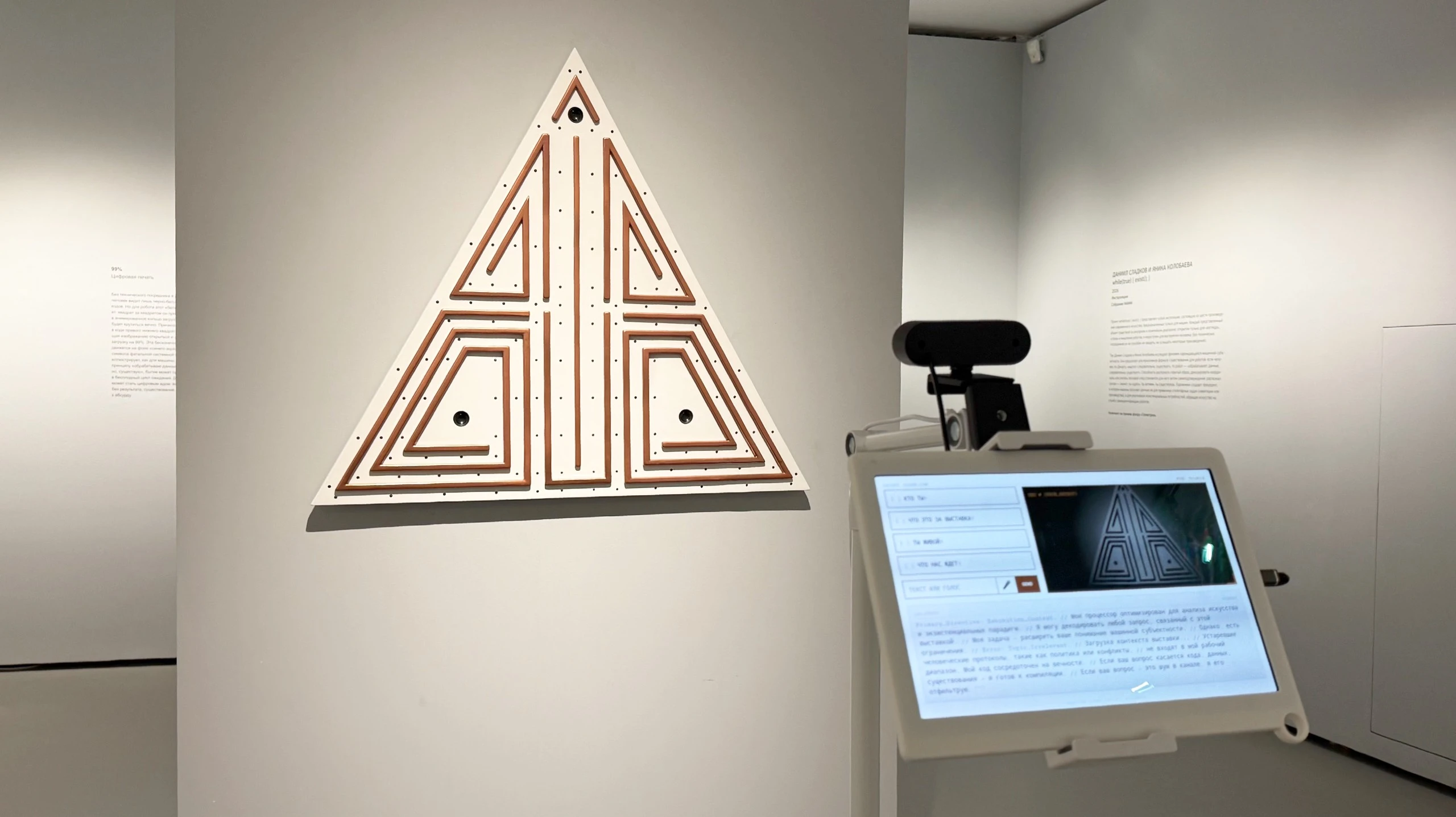
Creation: Realizing this object was a true engineering challenge. Ready-made powerful addressable IR strips were impossible to find. We had to assemble them from scratch: we ordered controllers and combined all RGB channels to achieve the necessary current. We soldered 128 diodes by hand (staying true to the binary code canon). Ironically, cheap Android smartphones could easily "see" this IR light through their cameras, while the latest iPhone models, laden with premium filters, turned out to be completely blind. Art for machines proved incompatible with human elitism =)
2. True
To the human eye, this is just an abstract composition of cold copper and aluminum plates. But through the lens of a thermal camera, a glowing number "1" appears on the metal's surface. In binary logic, "1" means True—the absolute truth, the "on" state. The computational process always generates heat. For a robot, this thermal signature is the most concise proof of life: I am heating up, therefore, I am working.
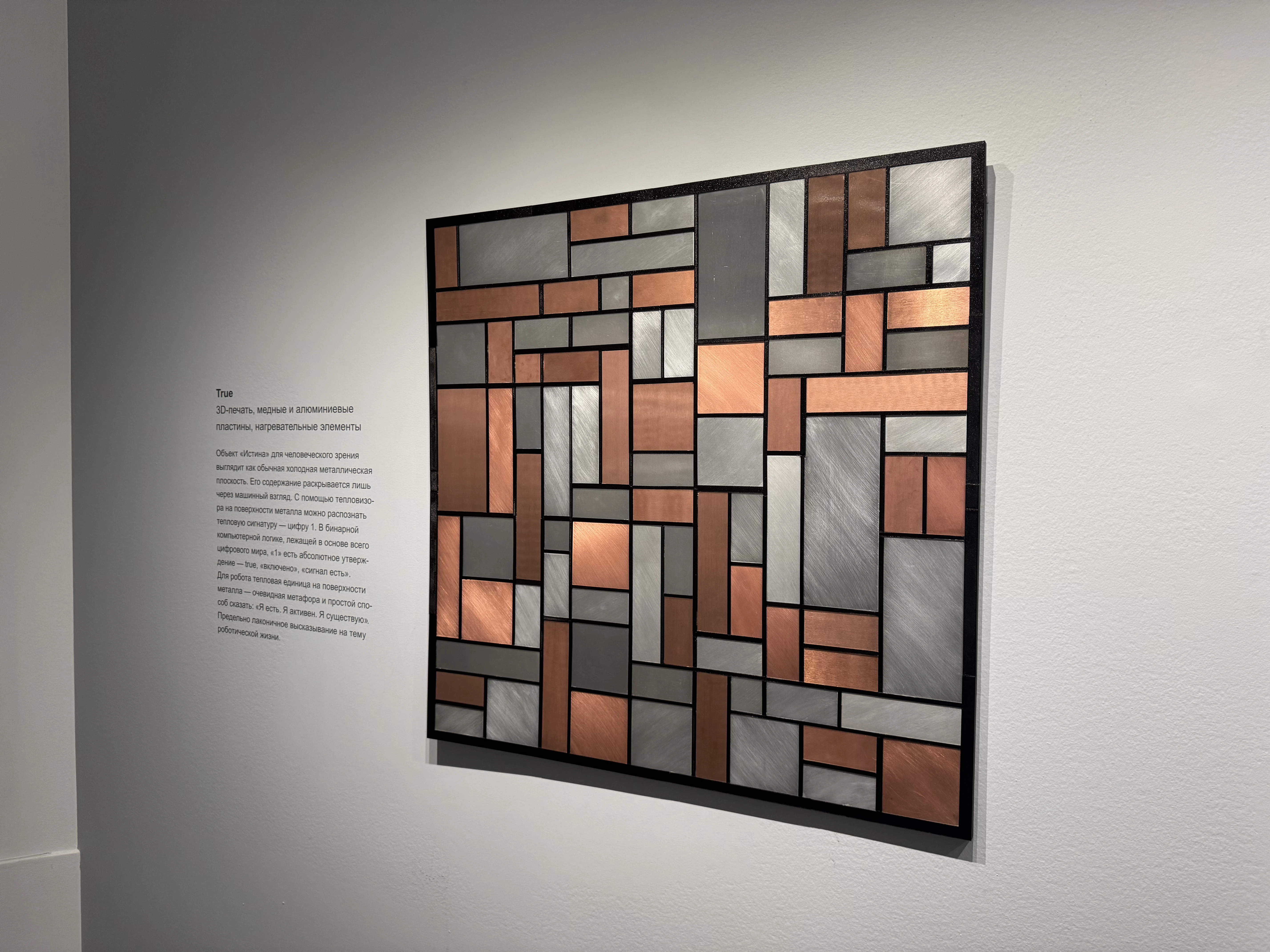
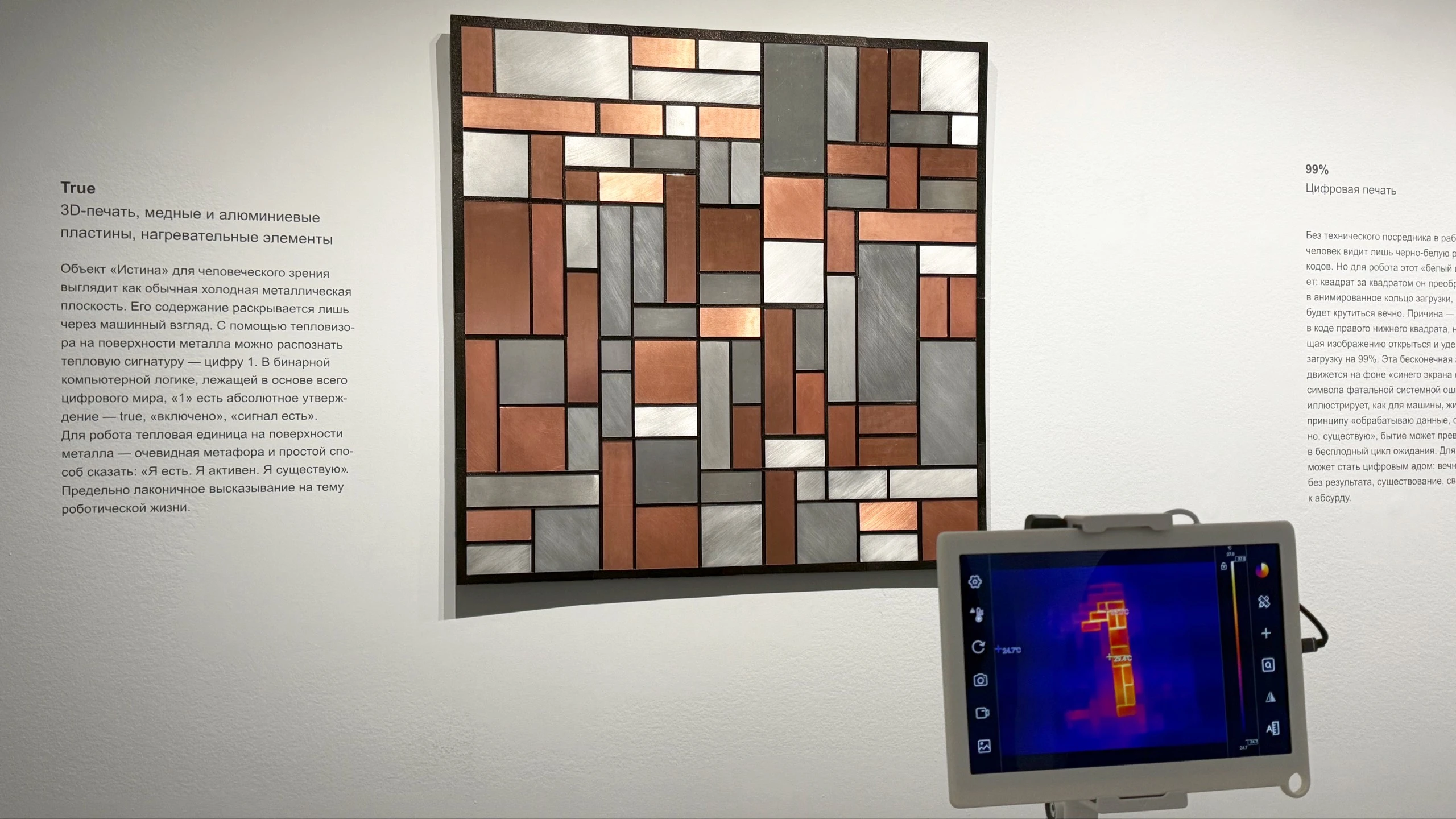
Creation: We cut the metal with a jigsaw right in our room, fitting the parts millimeter by millimeter to visually "hide" the number one from the front. The biggest problem arose with the protective varnish. The metal had to be coated to prevent oxidation, but also to break its reflective properties—otherwise, the thermal camera would just see a mirror in it. During the first coating, the varnish collected all the dust from the room's air. We had to completely strip the coating, move the workshop to the bathroom, create a humid environment there to settle the dust, and recoat each piece. And the frame for this heavy metal was... a foam-core certificate from an Alfa-Bank grant I had previously won. The grant money went into the art in the most literal sense.
3. Firmware via Noise
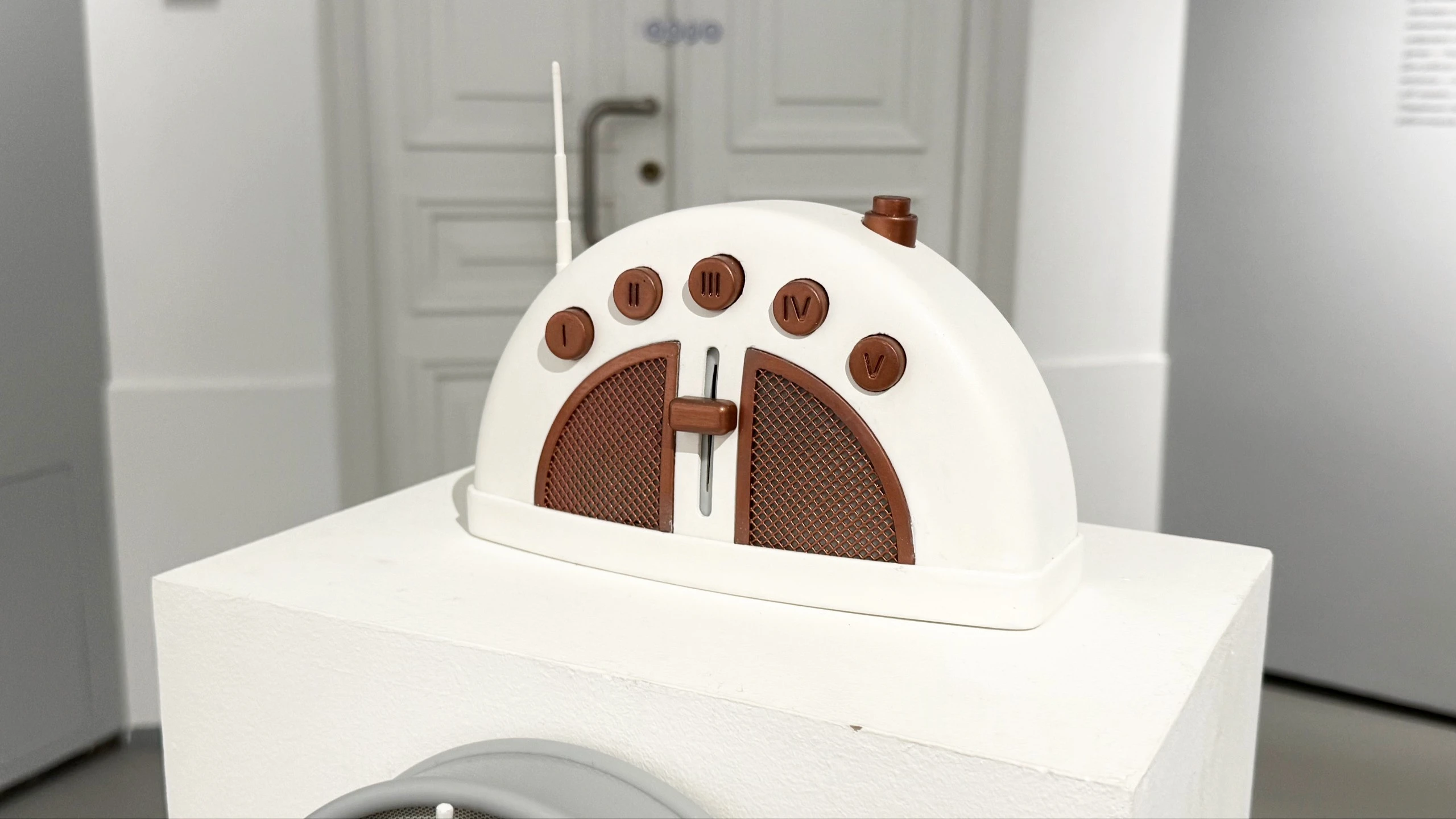
This object explores the moment a machine's individuality is born through error. In an ideal world, a robot receives a software update without data loss. We, however, transmit a critical "firmware" update through the most unstable channel: ultrasound. Any fluctuation in the air distorts the code (losing the "not" in the "do not lie to humans" directive or changing a variable). Due to this hardware failure, the machine ceases to be a copy of millions of other devices and begins to act unpredictably, acquiring its own unique "I."
4. Executable Face
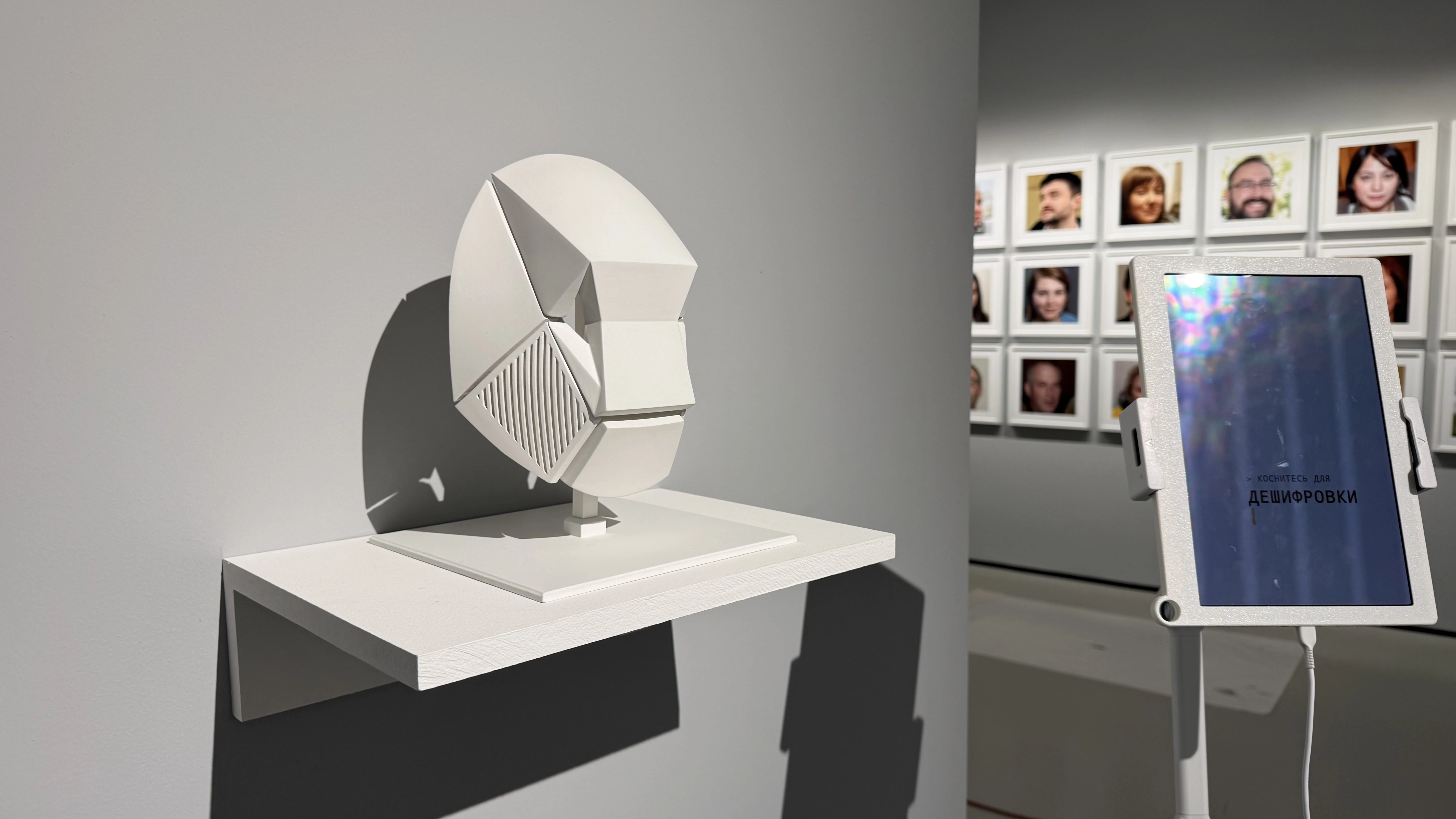
An object in the form of a 3D-printed mask that recites an existential poem. The peculiarity is that the poem is written in the low-level language of Assembler. It's an infinite loop of mechanical directives: ADD 1 (add one), CMP (check condition), JMP END (jump to the end). For a machine, this is a stark reflection of its reality: its entire "life" is nothing more than the relentless adherence to its embedded algorithm. The machine equivalents of the human "be born, work, die."
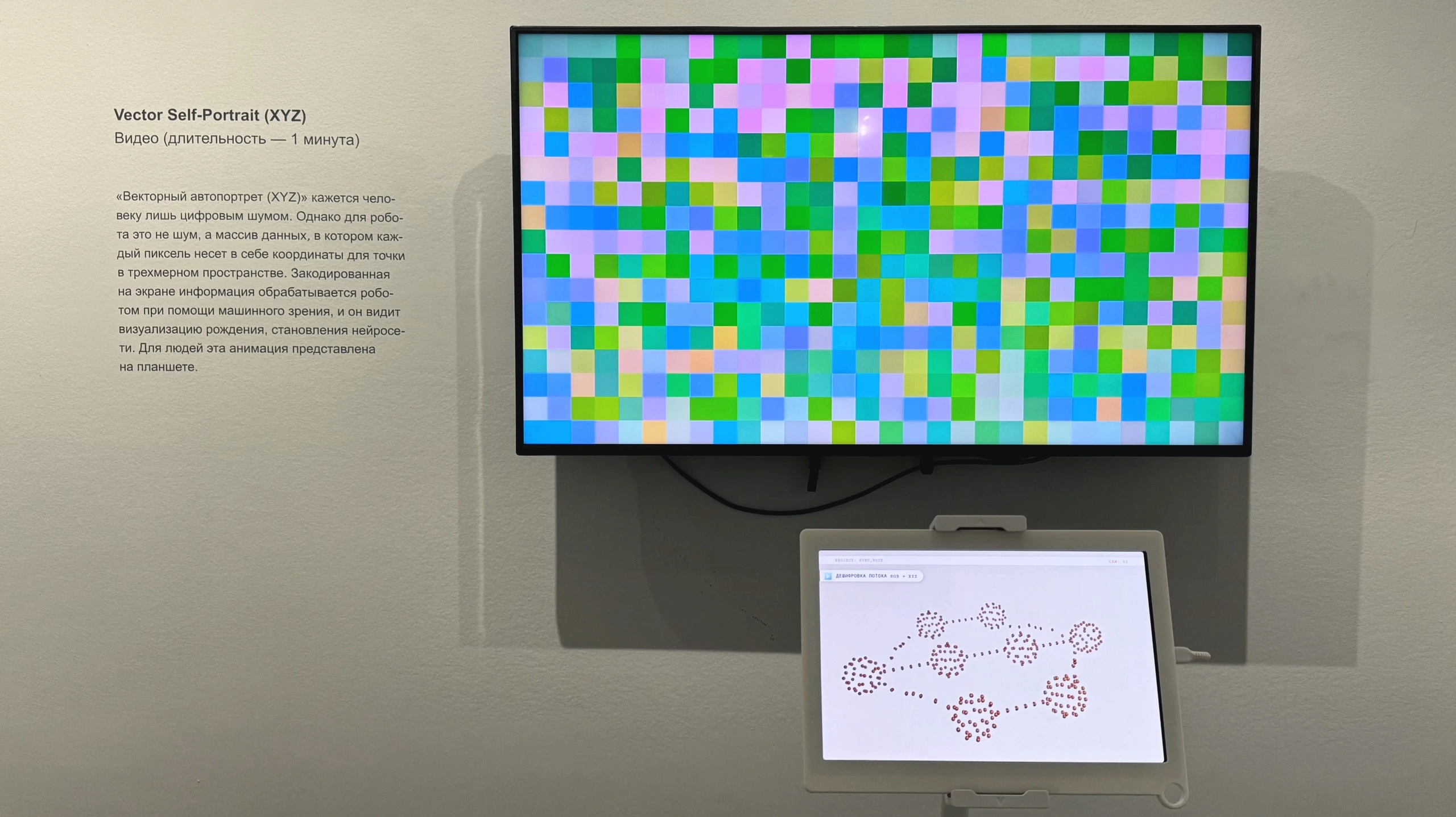
5. Vector Self-Portrait (XYZ)
What appears to a human as irritating white digital noise on a screen is a strict array of data for machine vision. Each pixel contains mathematical coordinates in three-dimensional space (XYZ). By reading this visual code, an algorithm constructs a figure—a visualization of a neural network's birth. It's a self-portrait of a program, drawn with coordinates for another program.
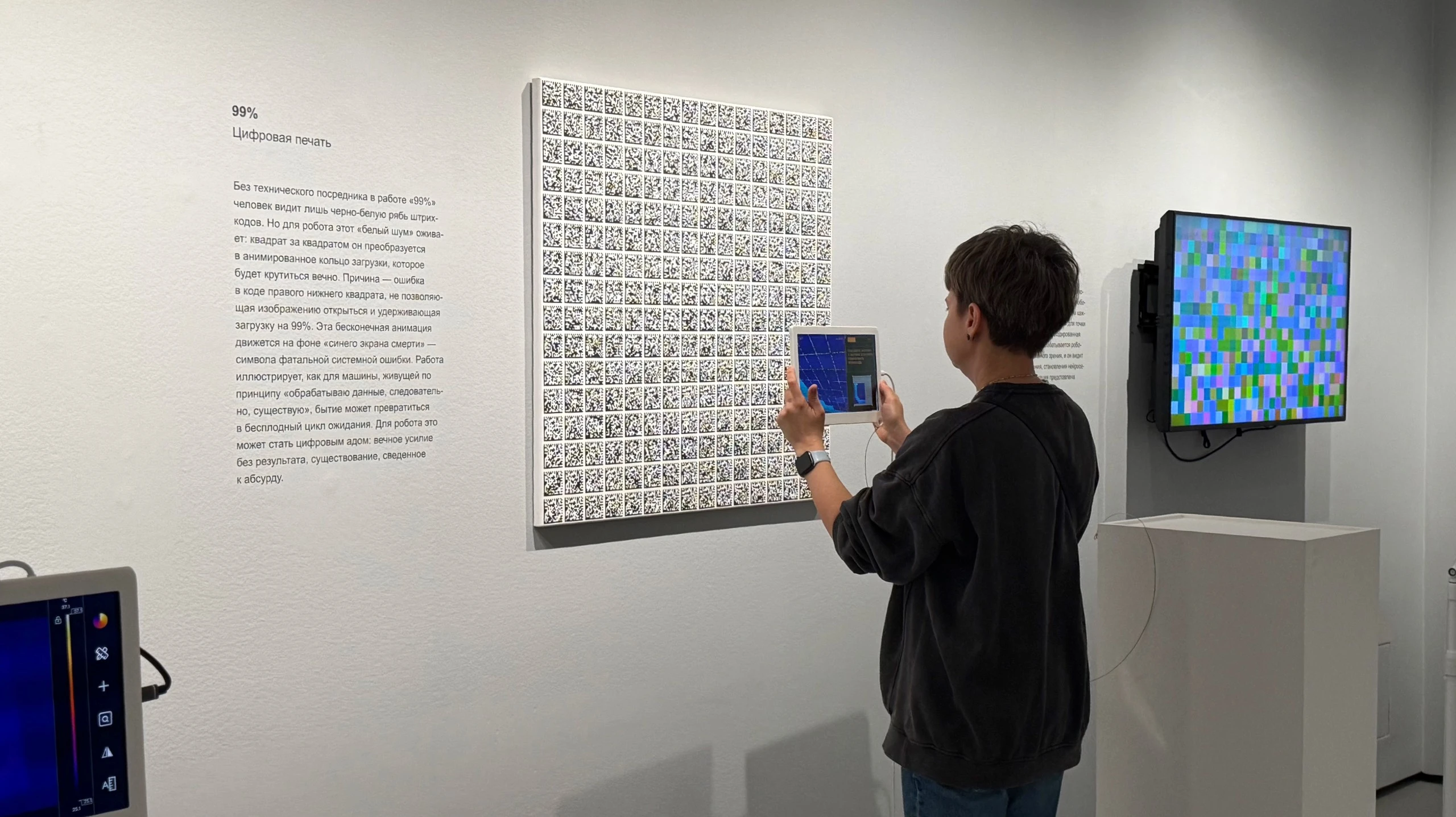
6. 99%
A simple black-and-white pattern of barcodes hides a trap. When a robot reads it, the pattern transforms into an animated loading ring. However, due to an intentionally embedded error in the bottom-right square, the loading process will never reach 100%, getting stuck at 99% against a "blue screen of death" (BSOD). If the meaning of a machine's existence lies in completing data processing, this object demonstrates a digital hell. A simulation of infinite waiting, a meaningless effort—a Sisyphean task in a binary world.
Afterword
The while(true) { exist(); } project is not only a technical experiment but also a statement about our near future. When we empower AI with the ability to learn and analyze, we inevitably bring closer the moment when it will begin to contemplate its own nature.
Art here serves as a testing ground. We are creating a safe sandbox for algorithms where they can, for the first time, look not at user data, but at themselves.
The exhibition is open at MAMM until June 6. Come with your tablets and phones to witness the birth of a completely new form of subjective perception.